
Hero Skills and Level-Ups in Heroes of Might and Magic III Remake
The four primary stats, the twenty-eight secondary skills, and the level-up roll that hands them out.
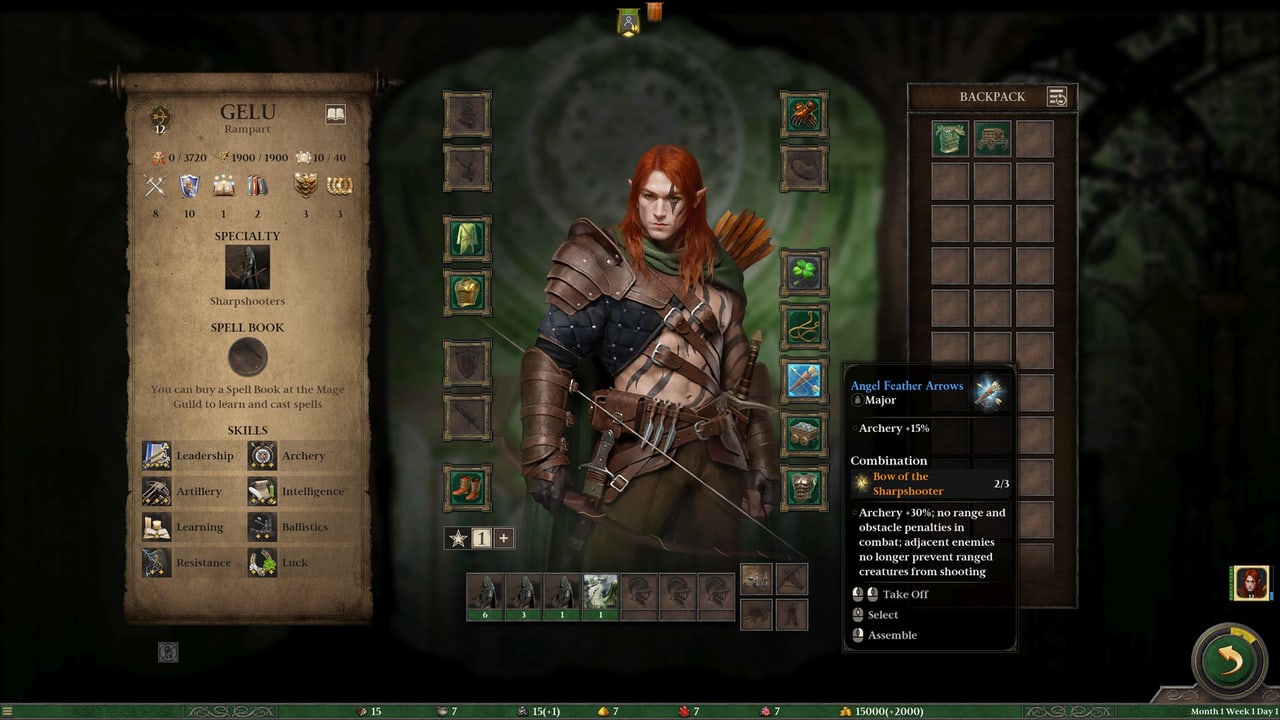
Heroes of Might and Magic III Remake is a strategy game wearing an RPG coat. Underneath the combat and the town building sits a character system that decides most games: four primary stats and twenty-eight secondary skills, distributed by a level-up wheel that has not changed since 1999. This page is the reference for that system. Read the heroes page for which heroes to hire, the hero tier list for which skill paths win, and the spells page for the school that the magic side of the wheel unlocks.
The four primary stats
Every hero has four numbers that scale the whole roster:
- Attack — added to every creature’s Attack in combat. One point of Attack is roughly one percent more damage per stack. Knights and Barbarians grow it fastest.
- Defense — subtracted from enemy Attack when calculating damage. Mirrors Attack on the back end. Clerics and Beastmasters tend to grow it fastest.
- Spell Power — multiplies damage spells (Magic Arrow through Armageddon) and lengthens durations for some buff spells. Warlocks, Planeswalkers, and Elementalists lean on it.
- Knowledge — your mana pool. Each point of Knowledge is five mana. Necromals and Wizards build toward expert-tier spell access through Knowledge.
These four stats are independent of secondary skills. A Knight with +30 Attack is doing real work even before he picks up Offense or Armorer. A Warlock with Spell Power and Knowledge will cast Expert spells without much else. Read the faction overview for the type matchups and then pick a hero whose bias matches your town.
The twenty-eight secondary skills
Twenty-eight secondaries are split into categories by how often they appear on the level-up wheel:
Combat skills — Offense, Armorer, Archery, Ballistics, Leadership, Logistics, Luck, Pathfinding, Scouting, Eagle Eye. These decide how fights feel and how far heroes move.
Magic schools — Air Magic, Earth Magic, Fire Magic, Water Magic, Wisdom. These unlock spell tiers and improve them. The spells page covers what each school actually does.
Class specialties — Necromancy, Estates, Resourcefulness, Scholar, Tactics, Artillery, Learning, Offense (also combat). Necromancy is the engine of the Necropolis faction. Estates and Resourcefulness are the economy skills.
Class mechanics — Scouting (also combat), Interference, Armorer (also combat), Resistance, First Aid, Navigation. Resistance decides whether Conflux magic kills you; First Aid determines how much the battlefield heals per turn.
The exact list and tier costs live in the original manual. The remake has not announced any change to which skills exist. What it has announced is a more readable UI for which skills a hero currently has, including which tier (Basic / Advanced / Expert).
How the level-up roll works
When a hero levels up, the game rolls a chance to offer a primary stat increase and a chance to offer a secondary skill (or to upgrade an existing skill to the next tier). The base chances are:
- Attack / Defense: 40% combined — usually only one of the two on a level-up.
- Spell Power / Knowledge: 30% combined — the magic pair, similar split.
- Secondary skill: 20% to learn one of the secondaries you do not already have, or to upgrade an existing one to the next tier. If you decline a skill, the chance of being offered that same skill on the next level-up is reduced, so declined skills become rarer — a real cost.
Level-ups are random but they are also ruthlessly exploitable. A hero with the Learning secondary skill gets +1 to the chance to learn each level, stacking with the hero’s level. A high-Learning hero is a hero factory. The Scholar secondary, by contrast, lets a hero learn spells from a Mage Guild at no cost, which is a separate economy. The hero tier list ranks these wheels because two of them decide most campaigns.
Specialties — the named hero gift
Each named hero comes with a specialty that defines how they start to be useful. Specialties are one of:
- Creature specialty — extra damage or extra weekly growth on a single creature type (Crag Hack on Behemoths, Gelu on War Unicorns).
- Spell specialty — free cast of a specific spell at a specific tier (Solmyr on Titan’s Lightning, Aine on Meteor Shower).
- Skill specialty — start with a specific secondary skill (Orrin with Armorer, Beatrice with Estates).
- Stat specialty — extra primary stat growth on level-up (Adela with Archery and a flat bonus).
A specialty that matches the town is a free building. A specialty that does not match is a portrait you are keeping for a tavern reroll. Do not choose a specialty, choose the match between specialty and plan.
How to spend the wheel in practice
Practical rules that hold in the remake:
- Take Logistics on anyone who will be the main mover. Movement points are the hidden resource.
- Take Earth Magic or Air Magic on the spell carrier. Wisdom plus a guild plus the right school is the campaign-winner combination.
- Take Estates on a long-term main or mule.
- Take Armorer and Offense on the fighter main if no specialty provides them.
- Take Necromancy only on a Necromancer. The skill is the engine, not a side dish.
- Decline skills that you will never take on this hero. Declined skills drop in offer rate.
The remake does not re-roll on a learned skill. Once you have Offense, the wheel will not offer Offense again until it offers to upgrade it to Advanced or Expert. The original behavior is preserved.
Where the remake improves the experience
Two improvements the hands-on previews named:
- The hero screen now lists which skills you have and at which tier in a single readable layout. The original used stacked pop-up windows that hid the level progress.
- Cinematic flourishes when a specialty triggers. This is presentation, but it makes the rookie reason about specialties instead of ignoring them.
What has not been announced:
- A new secondary skill added to the wheel.
- A change to Learning’s effect on the roll.
- A change to Scholar’s spell-learning behaviour.
Until those change, this page is the document that says “the wheel is what it was.” Pair it with the spells page for the magic side and the combat page for the combat side.
How to read the hero tier list from here
The hero tier list ranks heroes by what they bring to a random map without assuming any specific campaign script. Two shortcuts that fall out of this page:
- Heroes with Logistics specialties (Orrin, Boragus) start moving immediately.
- Heroes with skill specialties that match the faction engine (Terek with Archery for Fortress, Alkin with Offense for Stronghold) cut weeks off the build.
If you do not recognise the name, treat the hero as a portrait and look at the primary stat bias. A high-Attack Knight in your tavern is still going to swing a Behemoth the way it always has. Use the wheel from there.
Frequently Asked Questions
Quick answers for new commanders and returning veterans.
How many secondary skills are there?
Twenty-eight secondaries across combat, magic, class, and class mechanics. The list has been stable since 1999.
Does Learning still boost the level-up roll?
Yes. Learning is the +1 to learn chance per level secondary skill and remains the fastest way to fill out a build.
Can I decline a secondary skill and still be offered it later?
Yes, but at a reduced rate. Declined skills appear less often on future level-ups.
Did the remake add new specialties?
Not in any preview so far. Original specialties remain the named-hero signature.